Hampi Vijaya Vitthala Temple
- Wednesday, August 19 2009 @ 10:52 pm UTC
- Views: 23,350
Vijaya Vitthala Temple Complex in Hampi is one of the most advertised and popularised monuments of Karnataka. The temple complex is also house for the world famous Stone Chariot - an icon of the Karnataka Tourism. The temple dedicated to Lord Vishnu also known as Vitthala or Vithoba or Panduranga - the Ishta Devata of Shri Purandara Dasaru. The temple was started in the year 1513AD during the reign of King Krishna Deva Raya probably after his victory over Prataparudra Gajapati, the ruler of Orissa. Hence the prefix "Vijaya" which means victory is attached to the temple name. However, the project being so large and change in guard at Vijayanagara, the temple was not complete until 1565 when the empire fell.
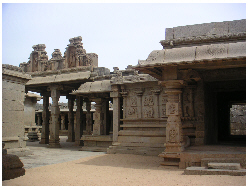 Situated in the Royal Enclosure, this temple for Lord Rama is popularly called “Hazari Rama Temple” or “Hazara Rama Temple” because of the large number of Ramayana panels on the walls. This temple is believed to have been the private place of worship of the Royal family.
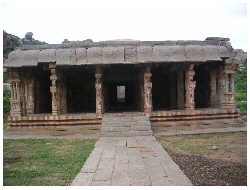 This monument, a few metres to the east of
 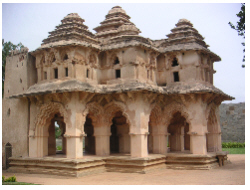 Lotus Mahal, also known as Kamal Mahal or Chitrangini Mahal is situated in the Zenana Enclosure of the monuments. It is a ticketed monument and a single ticket would let you into the Zenana Enclosure covering several monuments including [story:elephant-stables Elephant Stables]. The term Zenana refers to the Women and Zenana Enclosure in general would refer to the Queens’ enclosure along with the servants’ quarters around and private temples.
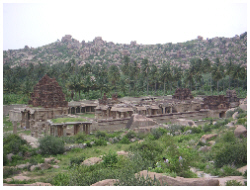 Believed to have been built during King Achyuta Deva Raya (1530-1542) by an officer Salakaraju Tirumaladeva, this temple, though not as large or beautiful as Vitthala Temple, is still a beautiful and sizeable monument. Though dedicated to Thiruvengalanatha or Lord Venkateshwara, the temple is known by the King under whose reign it was built.
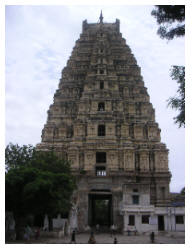 The temple, often called Pampapathi temple, is the most sacred of the temples of this place. Historically speaking, this temple has an uninterrupted history from about the 7th century. The temple contains the shirines of Lord Shiva, Pampa and Bhuvaneshwari. What was once a small shrine, in course of time, developed into a large complex under the Vijayanagara rulers. At present, the main temple consists of a Sanctum, three ante chambers, a pillared hall and a Mukha Mantapa also called Ranga Mantapa or an open pillared hall. A pillared cloister, entrance gateways, courtyards, attendant shrines and other mantapas surround the temple. In 1510 A.D. Krishnadevaraya added the above-mentioned Ranga Mantapa.
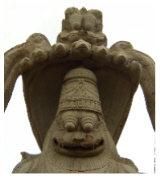 The statue of Lakshmi-Narasimha is also popularly called Ugra Narasimha, meaning Narasimha of terrifying countenance. It is hewn out of a rock in-situ. According to an inscription found here, it was executed in 1528 A.D. during the rule of king Krishnadevaraya. Originally, the icon bore a smaller image of Lakshmi sitting on his lap. This gigantic image, 6.7 meters in height, was mutilated and the figure of Lakshmi was entirely damaged and vandalized in 1565 A.D. Narasimha with an articulately chiseled and well delineated mane and large bulging eyes and broad chest still retains His awesome charm. He is seated on the coils of the snake Adisesha, who rises behind him with seven hoods, which serve as a canopy. The entire image is set within a Makara torana, or arch, with a lion-mask above the hoods of Adisesha.
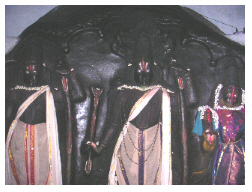 The Kodanda Rama Temple is situated towards the east of Hampi at the end of the